when you believe you are undeserving
you open yourself to unsuitable company
who hoodwink you through false assurances
these culprits may be volatile
combative and disrespectful
with a persistent self-referential attitude
sweetness, tension and acting out
become recurring themes
played over and over again
like looping cassette tapes
yet after each explosion
you get to breathe a peculiar kind of calm
coz you don’t have to walk on eggshells
at least not for another while
you go for long walks alone
interacting with strangers
you listen to distant cheerful voices
celebrating some family occasion
while mourning your own unforeseeable exile
Showing posts with label Barriers. Show all posts
Showing posts with label Barriers. Show all posts
Sunday, April 8, 2012


Tuesday, September 27, 2011
admiration vs. love
I never expected to encounter these welcomed lines by Alice
Miller that mirrored the hidden motivations of my heart.
“Others are there to admire him, and he himself is constantly occupied, body and soul, with gaining that admiration. This is how his torturing dependence shows itself. The childhood trauma is repeated: he is always the child whom his mother admires, but at the same time he senses that so long as it is his qualities that are being admired, he is not loved for the person he really is at any given time. In the parents' feelings, dangerously close to pride in their child, shame is concealed— lest he should fail to fulfill their expectations...
It is thus impossible for the grandiose person to cut the tragic link between admiration and love. In his compulsion to repeat he seeks insatiably for admiration, of which he never gets enough because admiration is not the same thing as love. It is only a substitute gratification of the primary needs for respect, understanding, and being taken seriously —needs that have remained unconscious.
The grandiose person is never really free, first, because he is excessively dependent on admiration from the object, and second, because his self-respect is dependent on qualities, functions, and achievements that can suddenly fail...
This combination of alternating phases of grandiosity and depression can be seen in many other people. They are the two sides of the medal that could be described as the "false self," a medal that was actually once given for achievements...
An actor, for example, at the height of his success, can play before an enthusiastic audience and experience feelings of heavenly greatness and almightiness. Nevertheless, his sense of emptiness and futility, even of shame and anger, can return the next morning if his happiness the previous night was due not only to his creative activity in playing and expressing the part but also, and above all, was rooted in the substitute satisfaction of old needs for echoing, mirroring, and being seen and understood. If his success the previous night only serves as the denial of childhood frustrations, then, like every substitute, it can only bring momentary satiation.
In fact, true satiation is no longer possible, since the right time for that now lies irrevocably in the past. The former child no longer exists, nor do the former parents. The present parents—if they are still alive—are now old and dependent, have no longer any power over their son, are delighted with his success and with his infrequent visits. In the present, the son enjoys success and recognition, but these things cannot offer him more than they are, they cannot fill the old gap. Again, as long as he can deny this with the help of illusion, that is, the intoxication of success, the old wound cannot heal. Depression leads him close to his wounds, but only the mourning for what he has missed, missed at the crucial time, can lead to real healing.” Chapter on "The Grandiose Person" -- Alice Miller
* False Self: A child who had to attend to a chaotic family of origin and the constant demands generated by this chaos, missed out on developing his or her true self. He or she had to adopt a false self in order to survive. For example, a boy grew up as a substitute husband to his mother, because the father had a paranoid personality disorder. That child had no chance to live out his childhood, because he was required to take on the role of an adult before his time. There is much more I could write about this interesting theory, but for now I only have time to give you a glimpse.”
Sunday, March 13, 2011
givers and takers
Givers tend to fall into the hands of takers. It makes sense. Exploitative folks cannot implement their tactics on individuals similar in kind. While the strategies may vary, the one common denominator of takers fits this lamentable yet true description:
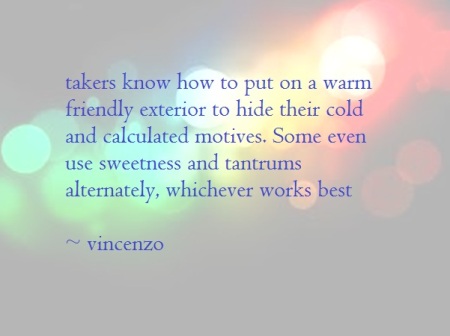
A pastor friend said givers seek to resolve conflicts without causing upset. They attempt to back away from toxic situations using discretion. He explained how useless this is when dealing with manipulators. Put bluntly — there’s no friendly way to get away. Furthermore (the pastor friend concluded) givers need to accept they may even be labelled the bad guy.
~ intuitivefeeling

A pastor friend said givers seek to resolve conflicts without causing upset. They attempt to back away from toxic situations using discretion. He explained how useless this is when dealing with manipulators. Put bluntly — there’s no friendly way to get away. Furthermore (the pastor friend concluded) givers need to accept they may even be labelled the bad guy.
~ intuitivefeeling
Friday, December 31, 2010
Rollerblading in my Veins


photo image by http://www.inlineskating.com/
I've carried skating in my veins since childhood. It all began by watching a classmate named Neil Hill maneuver effortlessly on ice skates in a way that combined grace with physical strength. I remember the rush I'd get as I fastened my laces with a hook-like gadget, while strangulating the veins of my arches. The music then of the 60s and 70s elevated the spirit with the anticipation of capturing the heart of a pretty girl with some fancy footing and show of speed... which never happened. I could recognize the smell of an arena blindfolded. It was an amplified olfactory version of a hockey sweater that combined sweat with synthetic fiber.
[fast forward a few decades...] I continue skating today, but now it’s OUTdoor INline skating in the middle of a metropolitan park. I've purchased over the years all kinds of sporty paraphernalia from spongy, but subtle protective padding, wrist guards, nutcase multi-sport helmet, oversized shades, poliester long sleeve tops, baggy over-the-knee pants with netting inside, MP3 with ear buds, skate bag and a black bandana [tucked inside the helmet] giving that Johnny Dep gypsy look. You could say these are my toys and after I finish I put the accessories into one easy-to-find container. The advantage I have is it can be used for biking too.
[fast forward a few decades...] I continue skating today, but now it’s OUTdoor INline skating in the middle of a metropolitan park. I've purchased over the years all kinds of sporty paraphernalia from spongy, but subtle protective padding, wrist guards, nutcase multi-sport helmet, oversized shades, poliester long sleeve tops, baggy over-the-knee pants with netting inside, MP3 with ear buds, skate bag and a black bandana [tucked inside the helmet] giving that Johnny Dep gypsy look. You could say these are my toys and after I finish I put the accessories into one easy-to-find container. The advantage I have is it can be used for biking too.
At first, I thought going inline skating would be a great way of meeting people, but I quickly learned I had to lower my expectations. The majority of the skaters are in a younger age bracket so there’s a generation gap there that I didn't have to ponder about as a child or teen. Don't get me wrong. There are older men who are allowed into the inner circle, but you have to be a trainer and into roller speed racing which isn’t my area of expertise nor interest.
Accepting the role of an outsider means learning to enjoy the physical workout at face value. People may gather together in a common place to participate in a common activity, but have nothing else in common week after week... I think that is why I enjoy biking, because it's easier on my psyche. I have no social expectations of any kind. It's enough to go here and there and get back to my apartment in one piece.
One day I saw a bumper sticker that read something to this idea: “Biking isn’t easy, but that’s what makes it fun.” It has been therapeutic for me to do something that involves risk. It's one step toward developing vulnerability in other spheres where social interaction is the risk factor. Kierkegaard says that courage would have no meaning without opposition. Maturity means taking a leap of faith to show care in a world where concern for others is superficial at best.
“When man contemplates history as it is, he is forced to realize that he is in the iron grip of an existence that seems to have no real care, nor concern for his pain and suffering.” ~ Laura Knight Jadczyk
Accepting the role of an outsider means learning to enjoy the physical workout at face value. People may gather together in a common place to participate in a common activity, but have nothing else in common week after week... I think that is why I enjoy biking, because it's easier on my psyche. I have no social expectations of any kind. It's enough to go here and there and get back to my apartment in one piece.
One day I saw a bumper sticker that read something to this idea: “Biking isn’t easy, but that’s what makes it fun.” It has been therapeutic for me to do something that involves risk. It's one step toward developing vulnerability in other spheres where social interaction is the risk factor. Kierkegaard says that courage would have no meaning without opposition. Maturity means taking a leap of faith to show care in a world where concern for others is superficial at best.
“When man contemplates history as it is, he is forced to realize that he is in the iron grip of an existence that seems to have no real care, nor concern for his pain and suffering.” ~ Laura Knight Jadczyk
Subscribe to:
Posts (Atom)